
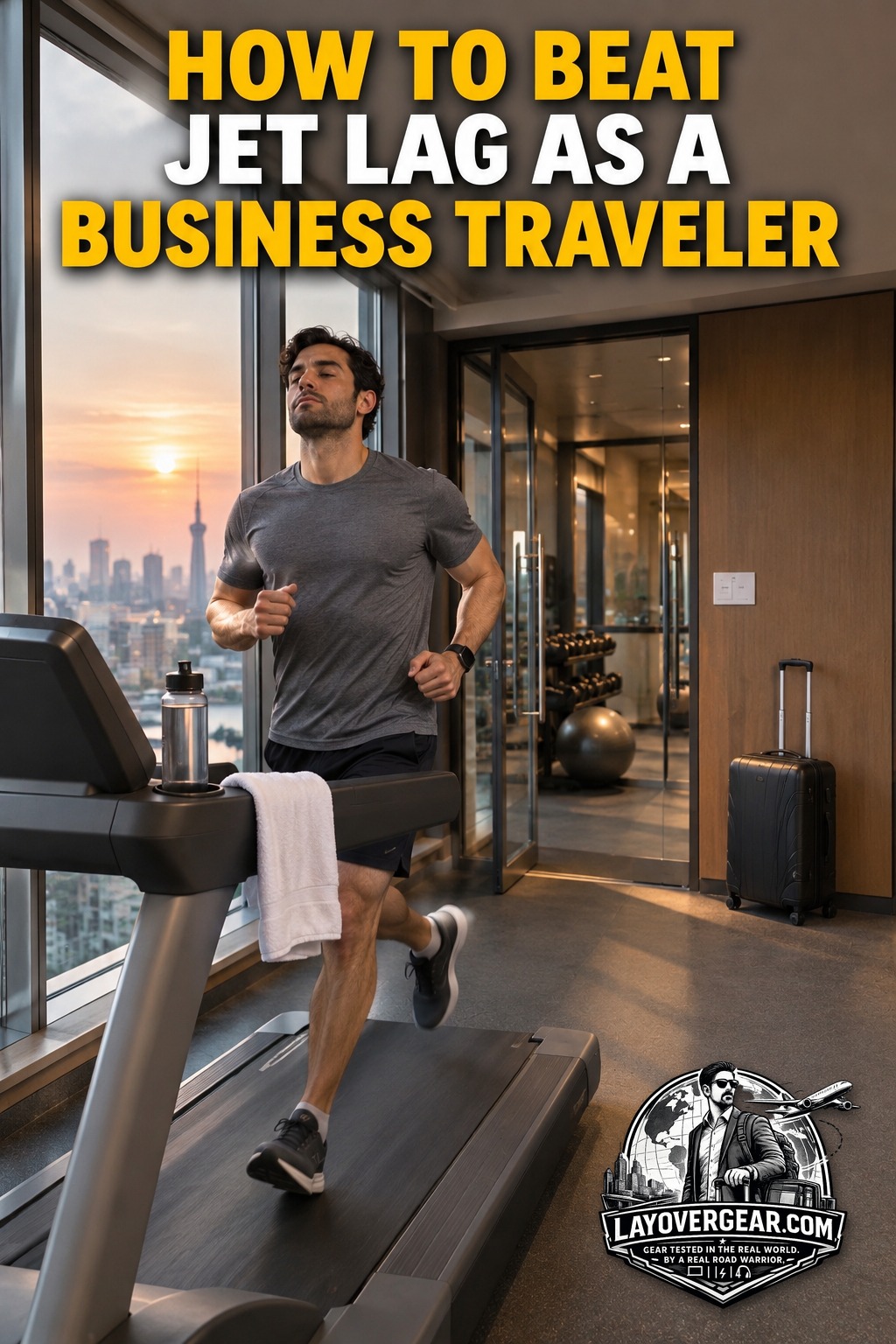
After two decades of business travel, I have tried just about every trick for how to beat jet lag. Melatonin, blackout everything, skipping caffeine, forcing myself awake until 9pm. Some of it helped a little. The one thing that works for me every single time is boring: I land, I get my bags settled, and I go do a long, steady cardio session. Run, treadmill, bike, whatever the hotel has. Then I eat, and I try to sleep when the local clock says it is time.
That is the whole method, and I call it land-and-lift. The tricky part is not the workout. It is the timing, because what time you land changes what you should do. If you are working out how to beat jet lag on a schedule where you are also expected to be sharp in a meeting, here is how I handle it.
What Jet Lag Actually Is
Jet lag is your internal clock being out of step with the clock on the wall. Your body wants to sleep at home time, and the destination insists it is mid-afternoon. The farther you travel, and the more time zones you cross, the bigger the gap. Light, meals, and activity are the signals that pull your clock toward the new time zone, and exercise is one of them. Knowing that is the first step in how to beat jet lag without gimmicks.
I am not a sleep scientist, and I am not going to tell you a workout cures it. What I can tell you is what works for me after a lot of flights, and what the research says about why it might.
The Land-and-Lift Method
When I land, the first goal is to stop living on home time. That means getting out of the airport, dropping the bags, and doing something hard enough to wake the body up. For me, that is a longer cardio session, not a heavy lifting day. Steady effort for 45 minutes to an hour, outside if the weather and the neighborhood allow it, because daylight helps the same clock you are trying to reset.
Then I stay on local time for the rest of the day. I eat at local meal times, I keep the afternoon nap short or skip it, and I aim to be in bed at a normal local hour. If you are asking how to beat jet lag for real, the schedule matters as much as the workout. The workout is just what drags you into the schedule.
It Is About When You Land
I do not change much between eastbound and westbound trips. What changes things is the local time when I touch down.
If I land in the morning, I am usually running on no sleep or a few bad hours on the plane. I skip the heroics, get daylight, do my cardio session once I have had food and water, and then push through to a local evening bedtime. This is the easy case.
If I land in the afternoon or evening, I decide whether I attempted sleep on the plane. If I did, I work out first and try to hold the schedule, then wind down for bed at local time. If I did not, a shorter, easier session earlier is smarter than a long one close to bedtime, because a hard effort right before bed can keep you up.
The research is a rough guide at best, but it points the same way. A 2019 paper in Frontiers in Physiology describes exercise in the roughly nine hours after your body-temperature low as nudging the body clock earlier, and exercise in the nine hours before it nudging the clock later. It is built on a small amount of evidence, and light exposure likely matters at least as much. I treat it as a reason to pay attention to timing, not a formula.
When the Trip Is a Night Shift
Some of my trips go east to a partner site where I end up working an overnight, a BPO partner team or a global support operation that runs on its own clock. That adds real stress to a body that is already confused, and it is where keeping a schedule matters most. Here is how to beat jet lag when the schedule itself is flipped.
My rule on those trips is to treat the shift as my day. I get up at the same time each day, do my workout before the shift starts the way I would before a normal workday, and eat meals around the shift. After the shift I go straight into sleep mode: a blackout mask, earplugs or headphones, and a dark room. I do not move my sleep around from day to day if I can help it. A steady schedule, even an odd one, beats a different one every night.
What I Pack for It
I keep the gear small and cheap. None of this takes up more than a corner of a carry-on, and if you are building your bag around it, our guide to the best packing cubes for business travel will keep it organized.
1. Gritin 100% Blackout Sleep Eye Mask — Best Sleep Mask
A good mask does the most for the least money, and it is what makes sleeping at the wrong time of day possible. This one blocks light without pressing on your eyes, which matters when you are trying to sleep after a night shift or on a daytime arrival. It costs less than a hotel breakfast.
2. WOD Nation Attack Speed Jump Rope — Best Hotel Room Cardio
When the hotel gym is a single treadmill with a line, or it is raining, a jump rope is the fastest way to get your heart rate up in a hotel room. It is adjustable, weighs nothing, and fits in a shoe. A few rounds will not replace a long run, but it keeps the routine going when the weather will not.
3. HPYGN Resistance Bands with Handles — Best for Strength on the Road
If your landing-day session is lighter, or you want a short strength block the next day, a set of resistance bands does the job with almost no packing cost. It is the one thing I add when I know the hotel gym is bad.
On long flights I also like to arrive rested enough to train at all. That is where a good neck pillow and a pair of noise-cancelling headphones earn their space, and our travel neck pillows guide covers the ones I actually pack.
A Few Cautions
This is my routine, not medical advice. If you have a heart condition or any health concern, or you are coming off a red-eye on no sleep, check with your doctor before a hard session, and back off if you feel dizzy or unwell. Hydrate more than you think you need to. And on trips that cross many time zones, expect it to take a few days no matter what you do, so give yourself some slack on the first day.
Frequently Asked Questions
Can exercise really help with how to beat jet lag?
It can help, but it is one tool among several. Light, meal times, and a steady sleep schedule matter just as much, and the workout works best when it is timed to your landing.
Should I work out right after I land?
For me, yes, once I have dropped my bags and had some food and water. Getting moving and getting daylight helps pull my body onto local time. If you are exhausted or ill, a walk is better than a hard session.
Does it matter whether I fly east or west?
In my experience, what matters more is the local time when I land and what I do next. Researchers do describe different timing windows for each direction, but I find landing time is the part I can actually plan around.
What if I land at night?
I keep it easy. A light session or a walk, a normal dinner, and a dark room, because a hard workout close to bedtime can keep you awake.
The Bottom Line
If you only change one thing about how to beat jet lag, change when you move and when you sleep, not what you pack. Land, move, get daylight, and hold a local schedule. Add a sleep mask and you have covered most of it for the price of a coffee. That is really all there is to how to beat jet lag for me, and it has worked on more trips than I can count.
Travel better. — Rex Boardman ✈️
Disclosure: This article contains affiliate links. As an Amazon Associate, we earn from qualifying purchases.